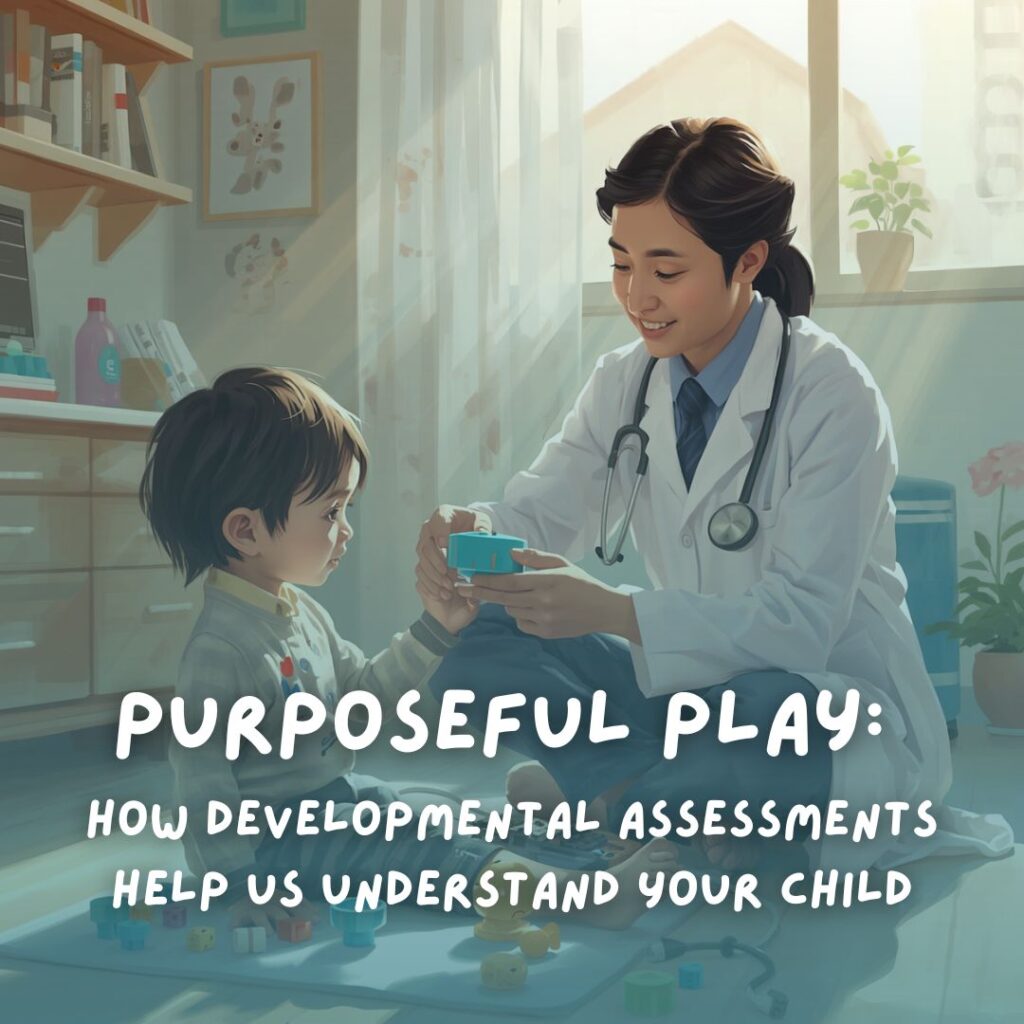
Parents often walk into a developmental consultation expecting a traditional “test”—structured questions, clear right-or-wrong answers, and a child seated across a desk. Instead, they may find their child on the floor/ table with toys, being gently engaged in what looks like ordinary play.
It can feel surprising, even confusing: How can something that looks like play be an assessment?
The answer lies in how children naturally learn and express themselves.
Young children, especially those with developmental differences, do not always demonstrate their true abilities in formal, highly structured settings.
Anxiety, unfamiliar environments, and limited language can mask what they know or can do. Play, on the other hand, is a child’s most natural mode of communication. It creates a space where they are more comfortable, engaged, and able to show their skills more authentically.
Assessment does not look the same for every child.
For young children, or for children who learn, communicate, or relate like a younger child, play is often the best “language” for assessment.
For older children and adolescents, the assessment may look more structured, using age-appropriate activities such as interviews, questionnaires, school-based tasks, problem-solving activities, academic screening, and discussion.
During play-based assessment, developmental pediatricians are not “just playing.” Each interaction is purposeful and guided. We observe how a child communicates—through words, gestures, eye gaze, or facial expressions. We look at social interaction, such as joint attention, turn-taking, and shared enjoyment. We assess problem-solving, flexibility in thinking, and imaginative play. We also take note of sensory responses, emotional regulation, and motor planning.
Importantly, while the interaction may appear informal, the assessment itself is not.
The tools and methods used are standardized, evidence-based and carefully selected based on the child’s age, developmental level, referral concerns, and context.
Structured observation schedules, developmental checklists, caregiver interviews and standardized tools help clinicians evaluate key developmental domains in a more systematic and consistent way.
Developmental assessment is not one-size-fits-all. Each child is unique, and the choice of tools and approach depends on the child’s age, developmental level, specific concerns, and context.
What looks like a simple game of bubbles, blocks, or pretend play may be a deliberate way to assess communication, social reciprocity, or sensory processing in that particular child. The clinician adjusts the interaction in real time to elicit meaningful responses, while guided by developmental principles, clinical reasoning, and standardized assessment frameworks.
Parents and caregivers are also essential partners in the assessment.
What the child shows in the clinic is interpreted together with the family’s observations, developmental history, school feedback, therapy reports, and the child’s everyday functioning across settings. A child may behave differently at home, in school, in therapy, and in the clinic; all of these observations help create a fuller and fairer picture.
In this way, developmental assessment balances two essential elements: scientific rigor and child-centered care. It is both structured and flexible—grounded in validated tools, yet responsive to the child in front of us.
Ultimately, the goal of a developmental assessment is not to have a child “perform” or “pass a test.” It is to understand how the child experiences the world, how they communicate, learn, and relate to others.
When we meet children where they are—through play—we gain a clearer, more compassionate, and more accurate picture of their development.
REFERENCES
American Academy of Pediatrics. Hyman SL, Levy SE, Myers SM. (2020). Identification, Evaluation, and Management of Children With Autism Spectrum Disorder.
American Psychiatric Association. (2022). DSM-5-TR: Diagnostic and Statistical Manual of Mental Disorders.
Bagnato, S. J. (2007). Authentic assessment for early childhood intervention: Best practices. Guilford Press.
Bayley, N., & Aylward, G. P. (2019). Bayley Scales of Infant and Toddler Development, Fourth Edition. Pearson.
Lord C, Rutter M, DiLavore PC, Risi S, Gotham K, Bishop S. (2012). Autism Diagnostic Observation Schedule, Second Edition (ADOS-2).
Barton EE, et al. (2013). Play-based assessment in early childhood. Journal of Early Intervention.
Lifter K, et al. (2011). Developmental play assessment in children with autism. Autism Research and Treatment.
Sparrow, S. S., Cicchetti, D. V., & Saulnier, C. A. (2016). Vineland Adaptive Behavior Scales, Third Edition. Pearson.