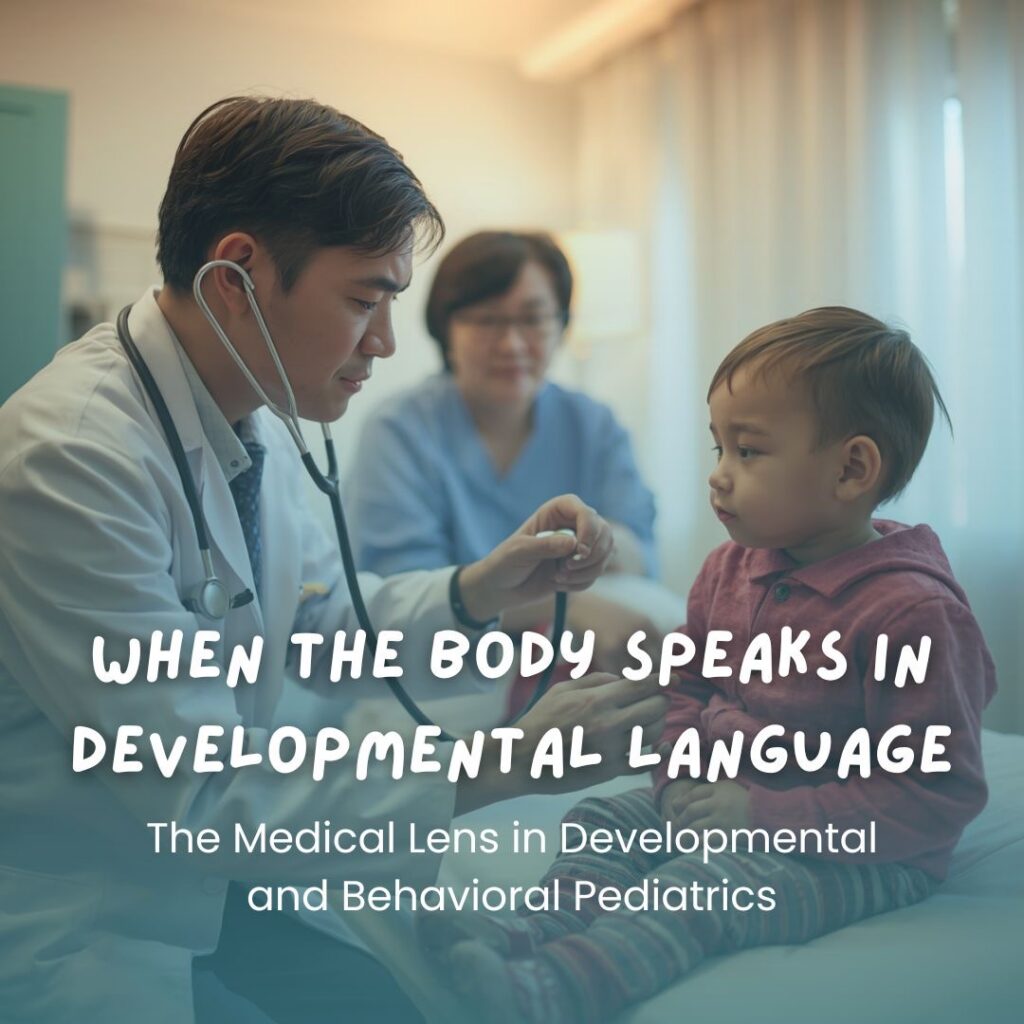
THE MEDICAL LENS IN DEVELOPMENTAL AND BEHAVIORAL PEDIATRICS
A guide for parents and families about why a developmental pediatrician orders blood tests, hearing tests, stool exams, and genetic panels. Because the body speaks. And the tests help us listen.
BEFORE WE BEGIN: Your Child As A Whole
Imagine your child as a beautifully complex house. The rooms — language, attention, behaviour, social connection — are what everyone sees. When something seems wrong in one of those rooms, most people rush in to fix the room itself. But a developmental pediatrician walks around the outside of the house first, looking at the foundation, the plumbing, the wiring, the roof. Because sometimes a flooded room has nothing to do with the room at all. A pipe burst two floors below.
That is the heart of what developmental pediatrics does. It asks not just what to call a child’s struggles — but what is causing them, what is feeding them, and what can be changed. The blood tests, the stool tests, the hearing tests, the genetic panels — none of them are random. Each one is a question the doctor is asking the body, because the body often knows the answer before anyone thinks to ask.
This guide walks you through every major chapter of your child’s body — the hormones, the gut, the brain’s electrical system, the immune system, the nutrients, the parasites, the environment, the genes, the sleep — and explains, in plain language, how each one connects to your child’s development. Not to alarm you. But to help you understand why, when a developmental pediatrician orders a test, they are not guessing. They are listening.
“A label names. A diagnosis explains. Our job is never finished at the name.”
The Art of Listening Before Looking: The Story, the Body, and the Brain
Before a single test is requested, the developmental pediatrician does something no laboratory can replicate: they sit down, slow down, and listen. Not just to the symptoms — but to the story. The timeline a mother gives is a diagnostic instrument. The moment she identifies when her child changed is a data point no blood test can generate. This is narrative medicine — the practice of receiving a family’s story not as background noise surrounding the clinical facts, but as the clinical facts themselves.
Then comes the examination. The colour of the conjunctivae whispers of iron before the blood count falls. The rounded belly speaks of parasites before any stool result confirms them. The open mouth and enlarged tonsils speak of a child who has not breathed easily at night in years. The subtle differences in the face and hands speak, in the quiet language of genetics, of a story still waiting to be named.
And then the neurological examination — the conversation with the brain itself, conducted through the body. The muscle tone tells us how the nervous system is holding everything together. The reflexes tell us how signals are travelling. The walk across the room tells us whether the cerebellum is coordinating as it should. The tracking of the eyes, the steadiness of the hands, the response to a voice — each one a sentence. Together, a paragraph that tells the developmental pediatrician where to look next.
Only then does the investigation begin. The tests are not a fishing expedition. They are targeted questions, each one born from something the history or the examination has already suggested. The ferritin is ordered because the conjunctivae were pale. The stool exam because the belly was round. The thyroid panel because the regression was gradual. The EEG because the words left at twenty-two months and never came back. Each test is the next sentence in a conversation that began the moment the family walked into the room — extending the story, giving it a number, a name, a confirmation, or opening a new chapter nobody had anticipated.
The laboratory result and the family’s lived experience are not separate sources of information. They are the same story, told in two different languages. The developmental pediatrician is trained to read both — and to find, in the space where they meet, the answer the child has deserved from the very beginning.
CHAPTER ONE: Hormones: The Body’s Invisible Instruction Manuals
The thyroid — your child’s electricity supply
Somewhere in your child’s neck sits a small, butterfly-shaped gland called the thyroid. Most parents have never thought about it. But this little gland produces a hormone that acts like electricity for every single cell in the body — including, most critically, the developing brain.
When thyroid hormone is too low, it is as if someone dimmed the power to the whole city. The brain runs on reduced energy. Signals travel more slowly. Language that should be forming — doesn’t. Attention that should be sharpening — wanders. A child with low thyroid hormone can look exactly like a child with autism or ADHD, when what they actually have is a brain running at sixty percent power because the thyroid isn’t doing its job.
The tragedy is that this is completely treatable with a simple daily tablet — but it must be caught early. That is why newborn screening exists. In the Philippines, however, not every lying-in clinic or rural health centre performs the newborn blood test reliably. And so some children arrive at a developmental clinic at age three or four with a brain that has been running on low power for years — not because of autism, not because of bad parenting, but because a small gland was never checked.
The opposite can happen too. When the thyroid produces too much hormone, the brain is flooded with stimulation. The child cannot sit still, cannot focus, gets upset over nothing. This child is often labelled as having ADHD — but what they have is an overloaded circuit, not a broken one. The moment the thyroid is treated, the behaviour changes. Not because the child changed their character. Because the electricity was fixed.
THINK OF IT THIS WAY
Thyroid hormone is the electricity that powers the whole city of the brain. Too little, and the lights go dim — language slows, attention wanders, everything takes more effort. Too much, and every circuit overloads at once — the child cannot sit still, cannot settle, cannot stop. The thyroid blood test tells us whether the city is getting the right amount of power.
WHY WE TEST: TSH AND FREE T4
Together, these two hormones tell us whether the brain’s electricity supply is too low, too high, or just right. TSH tells us how hard the body is working to stimulate the thyroid; Free T4 tells us how much actual hormone is being produced. This is often the very first test a developmental pediatrician orders — because it is one of the most treatable causes of developmental delay, and one of the most commonly missed.
Blood sugar and the adrenal glands — when the fuel supply is unstable
The brain is the most energy-hungry organ in the body. It consumes roughly twenty percent of all the calories a child eats — even though it weighs only about two percent of their body weight. For a developing brain, the fuel supply must be steady, reliable, and constant. Even a few episodes of very low blood sugar — something that can happen quietly in certain hormonal or metabolic conditions — can leave tiny marks on the brain’s memory and attention circuits.
The adrenal glands sit just above the kidneys and produce cortisol — the body’s emergency manager. When cortisol is not working properly, children can experience emotional storms, fatigue that looks like depression or withdrawal, and a difficulty regulating their reactions that is easily mistaken for a behavioural problem. The behaviour is real. But the source is biochemical, not a character flaw.
WHY WE TEST: FASTING GLUCOSE, HBA1C, AND CORTISOL
We are asking: is the brain getting a steady, reliable supply of energy? Are the emergency systems — cortisol and adrenaline — functioning properly? A child whose behaviour and alertness changes dramatically with meals — much better after eating, much worse when hungry — often has an answer hiding in these numbers.
CHAPTER TWO: The Brain’s Electrical System: When the Signals Go Wrong
Seizures that no one sees
Most people picture a seizure as a child falling to the floor and shaking. But many seizures are invisible — or nearly so. A child can have dozens of tiny electrical misfires in the brain every single day, each one lasting only a few seconds, and no one around them would know.
The child might just seem to pause briefly, stare into the distance, then continue as if nothing happened. Now imagine that happening during every lesson, every conversation, every moment of play. The child misses fragments of everything — the tail end of an instruction, the beginning of a social cue, the middle of a word. Over weeks and months, those fragments add up. The teacher says the child is inattentive. The family says the child is daydreaming. But what is actually happening is that the brain’s electrical system is cutting out, over and over again, like a phone call that keeps dropping.
There is a condition called Landau-Kleffner Syndrome where a child who has been speaking normally suddenly begins to lose language — not gradually, but dramatically, over weeks. Words disappear. The child becomes socially withdrawn. Parents are heartbroken and confused. But this is not autism. This is the brain’s electrical system misfiring specifically in the language areas, during sleep, when no one can see it. An EEG — a recording of the brain’s electrical activity — catches it. And treatment can restore language.
THINK OF IT THIS WAY
The brain communicates through electrical signals — millions of tiny sparks traveling between nerve cells millions of times a second. When those sparks misfire, it is like a phone call that keeps cutting out every five seconds. The person on the other end is not ignoring you. The line keeps dropping. The child is not daydreaming. Their brain’s signal is being interrupted.
IMPORTANT
Any time a child loses words they previously had — any time a child who was speaking begins to go silent — this is never a phase. It is treated as a relevant finding until we know otherwise. Language regression is an urgent signal from the brain that something must be investigated immediately.
WHY WE TEST: EEG (ELECTROENCEPHALOGRAM)
An EEG records the brain’s electrical activity through small, painless sensors placed on the scalp. For children with language regression, staring spells, or dramatic behavioural changes, we often request an overnight EEG — because some electrical misfires only happen during sleep and a daytime recording alone can miss them entirely. The EEG is not looking for personality or intelligence. It is listening to the brain’s electrical song, to find the notes that are out of place.
Neurotransmitters — the brain’s messenger chemicals
The brain’s billions of nerve cells do not touch each other directly. They communicate by releasing tiny chemical messengers called neurotransmitters across the gaps between them. Dopamine carries the signal of focus, motivation, and reward. Serotonin regulates mood, sleep, and the ability to feel calm. GABA keeps things steady and balanced. Glutamate drives the moments of learning and memory formation.
These chemicals are not manufactured out of nothing. They are built, every single day, from the raw ingredients the child eats. Iron is needed to make dopamine. Zinc is needed to help neurons communicate. Omega-3 fatty acids are literally woven into the walls of every brain cell, keeping them fluid and responsive. B vitamins are the factory workers who run the production lines. When any of these ingredients are missing, the factory slows down — and the child cannot focus, cannot self-regulate, cannot hold attention. Not because of a broken brain, but because a well-designed brain is running on empty.
WHY WE TEST:
SERUM FERRITIN, ZINC, MAGNESIUM, B12, FOLATE, OMEGA-3 INDEX
These tests map the brain’s raw ingredient supply. Ferritin — the body’s iron storage protein — is especially important because a child can have a perfectly normal blood count and still have a brain that is profoundly iron-deficient. By the time the blood count falls, the brain has often been running low on iron for months. These tests tell us whether the factory has the parts it needs to do its job.
CHAPTER THREE: The Gut: The Body’s Second Brain
Why what happens in the belly shows up in the brain
Most parents think of the gut as the place food goes. But scientists now understand that the gut is one of the most powerful communication systems in the body. It contains more nerve cells than the entire spinal cord. It produces roughly ninety percent of the body’s serotonin — the chemical that regulates mood and social comfort. It has its own immune system. And it is in constant, two-way conversation with the brain through a long pathway called the vagal nerve.
When the gut is in distress — from infection, from parasites, from inflammation, from the wrong foods — it sends distress signals up that pathway. The brain receives those signals and responds. In a child who cannot yet speak, that response looks like tantrums, aggression, self-injury, withdrawal, or sleep disturbance. The parents see a behavioural problem. What is actually happening is a gut in pain, speaking the only language the child has available.
In the Philippines, this connection is especially important. Parasites are present in the intestines of a significant proportion of Filipino children. Chronic diarrhoea, constipation, and abdominal bloating are so common that they are accepted as just part of childhood — when they are actually signals of a gut under siege. A non-verbal child with intestinal parasites may not be able to say that their stomach hurts. Instead, they scream when seated. They refuse food. They bang their head. They cannot sleep. Every single one of those behaviours is communication — and the developmental pediatrician’s job is to translate it.
THINK OF IT THIS WAY
The gut is like a second control room for the brain. The two rooms are connected by a direct telephone line. When the second control room is on fire, the first control room gets the alarm — and the child’s behaviour is the alarm bell ringing. You cannot silence an alarm by treating the bell. You have to find the fire.
WHY WE TEST: STOOL EXAMINATION (KATO-KATZ), STOOL CULTURE, GI EVALUATION
A fresh stool sample examined under a microscope can identify parasite eggs and give us a sense of the worm load. We pair this with a ferritin level to understand how much iron has been stolen. In the Philippines, we consider a stool examination mandatory for virtually every child with developmental concerns. A heavy worm burden is not a minor inconvenience. Worms actively steal iron and protein from the child’s developing brain. Treating the parasites is, in the most literal sense, treating the brain.
When food itself becomes the problem
There is a condition called celiac disease where the immune system, upon encountering the protein gluten found in wheat, launches a full-scale attack — sending inflammatory signals throughout the body and into the brain. What makes it particularly tricky is that many children with celiac disease have no obvious stomach symptoms at all. No diarrhoea, no vomiting, no discomfort a parent would notice. What they have instead is brain fog, emotional dysregulation, and difficulty concentrating — behaviours that look remarkably like ADHD, or sometimes even autism.
Once gluten is removed from the diet, something remarkable often happens: the brain fog lifts, behaviour improves, focus returns. Not because the child changed. Because the inflammatory fire was finally put out.
WHY WE TEST: ANTI-TTG IGA ANTIBODY AND TOTAL IGA
This blood test looks for the specific immune signature of celiac disease. We order it when a child has unexplained attention difficulties, behavioural problems, or developmental delay — especially if they also have iron deficiency or poor growth — because silent celiac disease can be the hidden driver behind a profile that looks purely neurodevelopmental.
CHAPTER FOUR: The Immune System: When the Body’s Army Attacks Its Own Brain
When a sore throat becomes a behavioural crisis
There is a phenomenon that remains one of the most startling in all of developmental medicine — and one of the most commonly missed in the Philippines. A child gets a sore throat. It seems like an ordinary strep infection — the kind that passes in a week with antibiotics. But then, days or weeks later, something changes overnight.
The child who was calm becomes suddenly obsessive, needing things done in a very specific way and becoming inconsolable when they are not. The child who was sleeping peacefully is now paralysed by fears at bedtime. The child who was doing well in school seems to have become a completely different person. The family is frightened and confused. What happened?
What has happened is this: the immune system, in fighting the streptococcal bacteria, produced antibodies — the soldiers sent to destroy the infection. But those antibodies, by a tragic case of mistaken identity, also attacked a part of the brain that governs behaviour, emotion, and movement. The infection is gone. But the immune system’s assault on the brain has left marks. The child is not having a breakdown. They are under friendly fire from their own immune system.
In the Philippines, where strep throat is common and often inadequately treated, this condition — called PANDAS — is not rare. It is a frequently missed one. And it is treatable. Treating the immune response, treating the remaining strep, and supporting the brain’s recovery can bring the child back. But only if someone ecognizes the pattern.
THINK OF IT THIS WAY
The immune system’s soldiers were sent to fight the infection. But they got confused about the enemy’s identity and started attacking the brain’s own control circuits instead. The child is not having a psychological breakdown. They are experiencing a medical crisis — friendly fire from within their own body — and they need medical treatment, not punishment or behavioural intervention alone.
IMPORTANT
The key clue is the suddenness. Autism develops gradually over months. ADHD emerges slowly over years. But PANDAS arrives like a storm — overnight, within days of an illness. A child who was completely well goes to bed and wakes up changed. This overnight transformation is the signal that something immune — not something developmental — has happened. It must not be missed.
WHY WE TEST: ASO TITRE, ANTI-DNASE B, THROAT CULTURE, ANTI-NMDAR ANTIBODIES
These tests look for the fingerprints of an immune attack. ASO titre and anti-DNase B tell us whether the body has recently been fighting streptococcal bacteria. Anti-NMDAR antibodies and other anti-brain antibodies tell us whether the immune system has turned on specific brain receptors. In the Philippines, where dengue is also endemic, we look carefully for post-dengue autoimmune brain processes, which can produce a similar picture of sudden, dramatic behavioural change after a fever.
CHAPTER FIVE: Nutrition: Building the Brain With the Right Materials
Iron — the most underestimated nutrient for the brain
If you were building a house, you would need steel for the structure, copper for the wiring, concrete for the foundation. Take away the steel and the walls sag. Take away the copper and the lights go out. The brain is built the same way — it needs specific materials at specific times, and the most critical of all those materials is iron.
Iron is not just about red blood cells. In the brain, iron is required to build myelin — the insulation that wraps around nerve fibres and allows electrical signals to travel at full speed. Iron is also needed to manufacture dopamine, the neurotransmitter of focus, motivation, and reward. A child without enough iron is not just pale and tired. Their nerve signals are travelling at a fraction of normal speed. Their dopamine system is under-resourced. They cannot focus, cannot regulate their emotions, cannot hold attention — and they will be labelled inattentive or hyperactive when the real problem is that their brain’s raw materials ran out.
Here is what surprises most parents — and even many doctors. By the time a child’s blood count drops and anaemia appears on a routine test, the brain has already been running low on iron for months. The blood count is the last thing to fall. The brain suffers first, quietly, invisibly, for a long time before any test that most clinics routinely run would catch it.
THINK OF IT THIS WAY
Iron is the copper wiring of the brain. Without enough copper, the lights flicker, the signals travel slowly, the circuits overheat. A child with iron deficiency is like a house where the wiring is faulty — not because the architect designed it badly, but because someone forgot to put in enough copper. Fix the wiring, and the lights come back on.
WHY WE TEST: SERUM FERRITIN — NOT JUST A FULL BLOOD COUNT
Ferritin is the body’s iron warehouse. When ferritin is low, iron stores are depleted even when the blood count looks perfectly normal. A child can have a haemoglobin level that any doctor would call normal, and a brain that has been severely iron-deprived for a year. We treat ferritin below 30 ng/mL as significant in any child with attention difficulties, sleep problems, or developmental concerns. Iron supplementation in iron-deficient children with ADHD-like presentations often reduces symptoms substantially — sometimes enough that no further medication is needed.
Iodine — the nutrient that programs the brain before birth
Iodine is a mineral that the thyroid gland uses to manufacture thyroid hormone. Without iodine, there is no thyroid hormone. And without thyroid hormone during pregnancy and early infancy, the brain does not develop properly. It is as simple — and as serious — as that.
Most of the Philippine archipelago sits on iodine-poor soil. A pregnant mother who is iodine-deficient may not know it — she feels well, her pregnancy seems normal, nothing alerts her. But her baby’s developing brain, in those critical first months in the womb, is being starved of the chemical it needs to wire itself correctly. Mild and moderate iodine deficiency — far more common than the severe form — quietly steals eight to thirteen IQ points and makes learning harder for a lifetime. These children are not disabled in obvious ways. They are simply operating below their potential — and neither they nor their families will ever know why, unless someone checks.
WHY WE TEST: URINARY SPOT IODINE
A urine sample tells us how much iodine is circulating in the body right now. We also ask about iodized salt use at home — because the simplest population-wide solution is iodized salt, and yet many Filipino households either do not use it or do not know whether their salt is iodized. For pregnant mothers especially, this is one of the most important questions we ask.
Zinc, magnesium, B vitamins, and folate — the quiet helpers that run everything
If iron is the steel of the brain, then zinc, magnesium, and B vitamins are the screws, the solvents, and the electrical tape — the things without which nothing holds together. Zinc is needed for hundreds of chemical reactions in the brain. Children who are zinc-deficient often become extremely selective eaters — they lose the ability to taste food normally and narrow their diet to the few things that still register flavour. But a narrow diet means less zinc. Less zinc means more selectivity. The cycle feeds itself, and the brain grows further depleted with every meal.
Magnesium regulates the brain’s glutamate system — essentially the volume control for neural excitement. Without enough magnesium, the brain runs too hot: anxious, irritable, easily overwhelmed, unable to settle. Many children described as emotionally dysregulated or hypersensitive have magnesium levels that have never been checked.
Vitamin B12 is essential for building and maintaining the myelin sheaths that insulate nerve fibres and keep signals running at full speed. A child who is severely B12-deficient can actually lose language and motor skills — a regression that is mistaken for autism or a neurological disease, when it is in fact a nutritional deficiency that reverses with treatment. Folate has a unique role in the brain’s own chemical recycling plant. There is even a specific condition — Cerebral Folate Deficiency — where the brain cannot receive folate even when blood levels look normal. The culprit is an antibody that blocks the folate doorway into the brain. Children with this condition develop autism-like regression and movement difficulties — but when treated with high-dose folinic acid to bypass the blocked door, many improve significantly.
WHY WE TEST: B12, FOLATE, HOMOCYSTEINE, ZINC, MAGNESIUM, FOLATE RECEPTOR ANTIBODIES
These tests map the brain’s chemical toolkit. Homocysteine is particularly useful: when folate and B12 are insufficient, homocysteine builds up in the blood and is directly toxic to neurons. Elevated homocysteine tells us that the brain’s recycling plant is struggling. Folate receptor antibodies are ordered specifically when a child with ASD-like features has unexplained regression — to look for Cerebral Folate Deficiency, a treatable condition that would be completely missed without this test.
Omega-3 fatty acids — the brain’s structural fats
The brain is approximately sixty percent fat — not the dietary fat found in fried food, but specialised structural fats, particularly a type called DHA, found in fatty fish and certain algae. DHA is literally built into the membrane of every neuron. It determines how fluid, flexible, and efficient those membranes are — and therefore how well signals travel between cells. Children in coastal Philippine communities who eat fresh fish regularly have a natural advantage here. Children in urban areas eating instant noodles and fast food often do not.
WHY WE TEST: OMEGA-3 INDEX
A simple blood test measures the proportion of omega-3 fats in red blood cell membranes — a reliable reflection of what the brain’s own cells contain. When it is low, targeted supplementation with high-quality fish oil or algae-based DHA becomes part of the nutritional plan. This is not a wellness trend. It is a structural repair to the walls of the brain’s cells.
CHAPTER SIX: Parasites and Infections: Invisible Tenants Stealing From the Brain
The most underestimated developmental threat in the Philippines
In many parts of the Philippines, intestinal parasites — roundworms, whipworms, hookworms, Giardia — are so common that families have stopped seeing them as a problem. The child passes worms occasionally. The belly is big. The child is thin despite eating. These are normalised. They should not be.
Worms living in the intestines are not passive residents. They are active competitors. Hookworms attach to the intestinal wall and drink blood — causing severe iron deficiency anaemia even in a child who is eating reasonably well. The worms take more than the food can replace. Beyond iron, worms cause chronic gut inflammation, interfere with protein absorption, and trigger a constant low-grade immune response that diverts the body’s resources away from brain building.
The behavioural consequence is often invisible to everyone except the developmental pediatrician. In a non-verbal child, the pain and discomfort of a bloated, inflamed gut presents as screaming, self-injury, refusal to sit, and explosive aggression — behaviours that are too often attributed to autism or a difficult temperament, when the real cause is a belly full of parasites that have never been treated. Deworming is safe. It is inexpensive. And it often produces a visible change in a child’s alertness and behaviour within weeks.
THINK OF IT THIS WAY
Worms are uninvited tenants who eat from your child’s food supply and pay no rent. Every nutrient they take is one less building block for the brain. Treating the worms is not just a public health measure. It is, in the most literal sense, treating the brain — because the brain is built from the nutrients that the worms are stealing.
WHY WE TEST: STOOL EXAM (KATO-KATZ METHOD), CBC, SERUM FERRITIN
A fresh stool sample examined under the microscope can identify parasite eggs and give us a sense of the worm load. We pair this with a ferritin level to understand how much iron has been stolen. In the Philippines, we consider a stool examination mandatory for any child with developmental concerns, a distended abdomen, teeth-grinding at night, disturbed sleep, or unexplained irritability.
Infections that leave marks on the brain
Some infections do their damage and leave. Others reshape the brain in ways that last for years — or forever. Japanese encephalitis — a mosquito-borne viral infection endemic in rural agricultural areas of the Philippines — can leave children with cognitive impairment, behavioural changes, and movement difficulties that look, to the unfamiliar eye, like autism or intellectual disability. These children are not newly autistic. They are recovering from a brain injury inflicted by a virus, and they need rehabilitation and medical follow-up — not a neurodevelopmental label applied in isolation.
Dengue — familiar to every Filipino family — is increasingly understood to have neurological consequences beyond the acute illness. Post-dengue brain syndromes, including a dramatic condition where the immune response triggered by dengue accidentally attacks brain receptors, can produce sudden and severe personality and behavioural changes in previously well children. Every developmental assessment must include a careful infectious history.
Perhaps the most heartbreaking is Subacute Sclerosing Panencephalitis — SSPE — a late complication of measles infection that can appear years after the original illness. The Philippines experienced major measles outbreaks in 2019 and 2020. In the years that follow, some children who were infected as infants will begin to show progressive changes in behaviour, learning, and movement. There is no cure. The only protection is the measles vaccine, given before the infection ever occurs.
WHY WE TEST: CMV URINE PCR, TORCH SEROLOGY, JE ANTIBODIES, DENGUE AUTOIMMUNE PANEL
These tests look for the fingerprints of infections — present or past — that may have altered brain development. In any child whose regression followed a fever, or who has a history of encephalitis, we look very carefully at the infectious history — because the infection may be the story, not just the background.
CHAPTER SEVEN: Environmental Toxins: The Invisible Thieves of Cognitive Potential
Lead — the neurotoxin hiding in plain sight
There is no safe level of lead in a child’s blood. This is not a matter of debate among scientists. Even the tiniest detectable amount causes measurable changes in brain function — reducing IQ, impairing attention and executive control, and increasing impulsive and aggressive behaviour. The brain of a young child, with its rapidly developing networks and more permeable blood-brain barrier, is uniquely vulnerable.
In the Philippines, lead exposure comes from sources that families rarely suspect. Old houses built before the 1990s may have lead-based paint on the walls, which flakes and becomes dust that young children inhale and ingest without anyone knowing. Some traditional herbal preparations — bought from markets, recommended by neighbours, given with the best of intentions — have been found to contain significant amounts of lead, arsenic, and mercury. Informal battery recycling, pewter cookware, and certain clay pots used for cooking are other sources. The lead enters quietly, without taste or smell, without any obvious immediate effect. It accumulates in the brain over months and years, and the cognitive consequences are attributed to everything except the true cause.
THINK OF IT THIS WAY
Lead in the brain is like rust in a machine’s gears — invisible from the outside, but slowly grinding down the precision of every movement. The machine still runs, but it makes more errors, moves less smoothly, responds less reliably. And the longer the rust goes untreated, the harder it becomes to restore the original function.
WHY WE TEST: BLOOD LEAD LEVEL
A simple blood test measures the concentration of lead in the blood. We request this for any child who has risk factors under six with developmental concerns, any child living in old housing, any child whose family uses traditional folk remedies or preparations, and any child with pica — the tendency to mouth or eat non-food objects — which is itself a sign of iron deficiency and can increase lead ingestion. If lead is found, the immediate priority is identifying and removing the source.
Pesticides — the farming community’s hidden risk
The Philippines is one of Southeast Asia’s heaviest users of organophosphate pesticides, applied at agricultural scale to rice paddies, vegetable farms, and fruit orchards. Children who grow up in farming communities play in fields, drink from water sources that may carry chemical runoff, and breathe air that carries pesticide drift during spraying. Their parents’ clothing brings it home.
These chemicals work by interfering with the nerve system — preventing the brain from clearing certain chemical signals after they have been delivered, causing neurons to fire continuously. In the chronic, low-level exposure experienced by children in farming areas, the effect is cumulative: reduced IQ, attention difficulties, impaired executive function, and developmental delays that accumulate invisibly over years of exposure. A child whose family farms, whose home is near fields, whose water source may be contaminated, deserves a careful exposure history as part of every developmental evaluation.
WHY WE TAKE A THOROUGH ENVIRONMENTAL HISTORY
Urine tests can detect the breakdown products of organophosphate pesticides, confirming exposure. But the most important test is the history itself: Where does the family live? What does the family grow? How close to the fields does the child play? When does spraying happen? This information, combined with laboratory results where needed, tells us whether the child’s environment is a contributing factor — and what must change.
CHAPTER EIGHT: Genetics: When the Blueprint Itself Has a Variation
What genetic testing actually tells us — and what it doesn’t
Genes are the body’s original instruction manual — the code that tells every cell what to be, what to build, and how to behave. When there is a variation in that code — a missing piece, an extra copy, a single-letter misspelling — it can affect the brain’s development in specific and sometimes profound ways.
But genetics in developmental medicine is not about finding a defect. It is about finding an explanation. When a family receives a genetic diagnosis for their child, it does not mean the child is broken. It means that for the first time, they have a real answer to the question they have been asking for years: why? Why does my child learn differently? Why do they struggle with this and not that? Why do they need what they need?
A genetic diagnosis changes management in concrete ways. It tells us which other organ systems to watch — because many genetic conditions affect the heart, the kidneys, the thyroid, or the immune system alongside the brain. It gives families access to condition-specific communities and support networks. It allows accurate genetic counselling for parents thinking about future pregnancies. And increasingly, it guides treatment: for some genetic conditions, knowing the specific gene mutation opens the door to targeted therapies that simply did not exist a decade ago.
The most commonly ordered genetic test in developmental paediatrics is the chromosomal microarray — a test that looks at the entire genome at once, searching for missing or extra pieces of genetic material. It finds a cause in roughly fifteen to twenty percent of children with unexplained intellectual disability or autism, making it the highest-yield single test in the field. Another critical test is for Fragile X syndrome — the most common inherited cause of intellectual disability — which affects not just the child but potentially their siblings, cousins, aunts, and uncles. Knowing about it matters for the whole family.
THINK OF IT THIS WAY
Genetic testing is like reading the original blueprint of a building. The blueprint doesn’t tell you the building is badly made — it tells you exactly which materials were used, which design choices were made, and which systems need extra attention. It is information. It is not a verdict.
WHY WE ORDER: CHROMOSOMAL MICROARRAY, FMR1 DNA TEST, WHOLE EXOME SEQUENCING
The chromosomal microarray looks at the entire genome for missing or extra pieces of chromosomal material and requires only a blood sample. The Fragile X test looks specifically for an expansion in one gene and is ordered in all children with unexplained intellectual disability or autism. Whole exome sequencing — which reads every gene individually — is ordered when the microarray is negative but a genetic cause is still strongly suspected. Together, these tests explain the unexplained in roughly one in three children with moderate to severe intellectual disability.
CHAPTER NINE: Sleep: The Brain’s Nightly Maintenance Window
Sleep is not a passive state. During deep sleep, the brain does the work that it cannot do while awake: it consolidates memories, clears metabolic waste products, repairs connections, and regulates the hormones that govern growth, mood, and stress response. For a developing brain, sleep is not optional maintenance — it is primary construction work.
When sleep is chronically disrupted — as it is in children with obstructive sleep apnea from enlarged tonsils and adenoids — the brain goes through every day in a state of neurological deficit. The frontal lobe, which governs impulse control, sustained attention, and emotional regulation, is the most vulnerable to sleep deprivation. A child with untreated obstructive sleep apnea can present with every feature of ADHD — hyperactivity, inattention, explosive emotions, poor impulse control — and yet have no ADHD at all. They have a brain that has been chronically deprived of the restorative sleep it needs to function.
Enlarged tonsils and adenoids are extremely common in young Filipino children. When these tissues grow large enough to partially block the airway during sleep, the brain detects the low oxygen and briefly wakes the child — dozens of times a night, often without the child or parent knowing. The child wakes in the morning exhausted. They fall asleep in class. They cannot regulate their behaviour. And they are sent for an ADHD evaluation, when what they needed was a sleep study and a conversation with an ENT surgeon. Treating the sleep apnea — often with a simple surgical procedure — can resolve all the apparent ADHD symptoms entirely, without a single dose of medication.
THINK OF IT THIS WAY
Imagine trying to study for an important exam after someone woke you up every ten minutes all through the night. That is every single school day for a child with untreated sleep apnea. Their brain is not broken. It is exhausted. And an exhausted brain cannot learn, cannot regulate, and cannot focus — no matter how much the child wants to.
WHY WE ORDER: POLYSOMNOGRAPHY (SLEEP STUDY) AND OVERNIGHT OXIMETRY
A sleep study records brain waves, oxygen levels, breathing patterns, and body movements during a full night of sleep. It is the definitive test for sleep apnea and other sleep disorders. For children where access to a full sleep lab is limited, overnight pulse oximetry — a simple clip on the finger that records oxygen levels through the night — is a useful first screen. We order a sleep study before prescribing stimulant medication for any child who snores, breathes through their mouth, sweats excessively during sleep, or wets the bed.
CHAPTER TEN: Adversity and the Brain: When Life Experience Becomes Biology
This chapter asks something uncomfortable: can difficult life circumstances — poverty, violence, neglect, loss, instability — actually change the biology of a child’s brain? The answer, supported by decades of research, is yes. Not metaphorically. Literally. At the level of genes, hormones, and neural architecture.
When a child lives with chronic, overwhelming stress, the body’s stress response system stays switched on for extended periods. The hormone cortisol, in short bursts, is protective. Cortisol chronically elevated is destructive. It suppresses immune function, disrupts sleep, and — most critically — damages the hippocampus, the brain region responsible for memory, learning, and emotional regulation. Children who grow up under toxic stress literally have smaller hippocampi. Their stress response system is calibrated for a world that is dangerous, unpredictable, and threatening. In a classroom, this looks like hypervigilance, emotional explosiveness, inability to concentrate, and difficulty trusting adults — all of which look, on a checklist, like ADHD or ASD.
In the Philippines, adverse childhood experiences are widespread: poverty, parental separation due to overseas work, domestic violence, natural disasters, and community instability all contribute to a landscape of early adversity. A developmental pediatrician who does not ask about these experiences — who treats only the brain and not the life — will miss one of the most powerful biological determinants of a child’s developmental trajectory.
THINK OF IT THIS WAY
A smoke detector that has been going off continuously for years has not become broken. It has become calibrated to detect smoke everywhere, because for a long time, everywhere was on fire. The child’s nervous system is not defective. It adapted to survive. Our job is to help it understand, slowly and safely, that the fire is out — and to give the brain the experiences it needs to turn down the alarm.
WHY WE TAKE A THOROUGH SOCIAL HISTORY
We ask about household composition, parental mental health, financial stability, exposure to violence, and significant losses or disruptions, because this information directly shapes our understanding of the biology we are seeing. The social history is not small talk. It is medicine. The family’s story is often the most powerful diagnostic tool available.
CHAPTER ELEVEN: Miguel’s Story: How a Developmental Pediatrician Reads a Life
Miguel is four years old when his mother, Mariel, finally brings him in. She has been told by three different doctors that he probably has autism. She is not sure what to do with that information. She just knows that something happened to her son — that he was there, and then somehow, he wasn’t.
The developmental pediatrician does not begin with a checklist. She begins with a question.
“Tell me his story. From the beginning.”
BEFORE HE WAS BORN
The story starts before Miguel takes his first breath.
Mariel is twenty-three years old and works in a local market. She had no prenatal check-ups until her seventh month — not because she was careless, but because the clinic was far and the fees were uncertain. She did not take prenatal vitamins. At home, they use whatever salt is cheapest, and no one has ever checked whether it is iodized. She ate mostly rice, dried fish, and whatever vegetables were affordable that week.
“Hindi naman ako nagkasakit, Doc. Normal lang ang buntis ko.” — I didn’t get sick, Doctor. My pregnancy felt normal.
What the doctor hears in this:
Normal-feeling and nutritionally sufficient are two very different things. The doctor is already hearing the first chapters of Miguel’s story: a pregnancy without iodine, without iron, without folate. A brain forming in the womb without the raw materials it needs to wire itself correctly.
BIRTH AND THE FIRST MONTHS
A healthy baby — but already missing something important.
Miguel was born full-term at a lying-in clinic. There was no newborn screening — the clinic did not offer it, and no one told Mariel it existed. He breastfed for two months, then switched to formula when Mariel returned to work. He babbled, smiled, reached for things. His lolo called him matalino. He had two ear infections in his first year — both treated with antibiotics at the health centre, apparently resolved.
What the doctor hears in this:
No newborn screening means congenital hypothyroidism and metabolic diseases cannot be excluded. Two ear infections in the first year means fluid behind the eardrum — hearing that is not quite right, not deaf but muffled, like listening through a wall. A baby learning language through a wall is a baby whose language development is starting with a handicap no one knows about.
EIGHTEEN TO TWENTY-FOUR MONTHS
The words came — and then they stopped.
Miguel said mama, papa, oo, ayaw. He was building something. Then, sometime between twenty and twenty-four months, the words began to go quiet. By his second birthday, he was mostly silent. He lined up cars. He did not respond to his name. His yaya said he looked through people rather than at them.
“Akala namin tinatamad lang siya. Sabi ng lola, lalaki lang siya — maingay din ‘yan sa oras.” — We thought he was just being lazy. Grandma said boys are like that — he’ll talk when he’s ready.
What the doctor hears in this:
This is regression — not delay. He had words. He lost them. These are different clinical pictures with different urgencies. A child who is slow to speak is on a different trajectory from a child who was speaking and stopped. The second trajectory requires investigation.
AGE TWO TO THREE
The body speaks, in the only language it has.
By age three, Miguel’s belly is distended. He grinds his teeth at night. He wakes frequently and sleeps poorly. He is pale — not dramatically, but noticeably. His diet has narrowed to rice, hotdog, and crackers. His tantrums are explosive, often around mealtimes, sometimes coming from nowhere.
“Nagtatantrum kasi masama ugali. Spoiled sa lola.” — He throws tantrums because of bad behaviour. He’s spoiled by grandma.
What the doctor hears in this:
The distended belly speaks of parasites. The teeth-grinding and disturbed sleep speak of pain. The pallor and narrowed diet speak of iron deficiency. The tantrums at mealtimes speak of a child in gut distress with no words to say where it hurts. Every single behaviour is communication. The developmental pediatrician’s job is to translate.
THE EVALUATION — AGE FOUR
A doctor who listens before she orders.
Rather than going straight to a developmental checklist, the doctor spends forty-five minutes with the family — asking about the pregnancy, the salt, the ear infections, the regression, the belly, the sleep, the tantrums. She examines Miguel head to toe: pale conjunctivae, distended abdomen, enlarged tonsils, mouth-breathing. She does not yet write the word “autism” anywhere. She is still reading the story.
What she orders: A full blood count and ferritin. A thyroid panel. A stool examination. A formal hearing test. A urinary iodine level. An overnight EEG. Six questions, asked to the body, in the language the body understands.
THREE WEEKS LATER — THE ANSWERS
Five causes. Five treatable problems.
Haemoglobin 8.2 — severe anaemia. Ferritin 4 — the iron warehouse is almost completely empty. Stool: heavy Ascaris and Trichuris worm burden. TSH mildly elevated with normal Free T4 — the thyroid is struggling. Hearing test: bilateral mild conductive hearing loss from fluid behind both eardrums. Urinary iodine: below normal range. EEG: normal.
What this means:
Five conditions. Five different organ systems. Five treatable problems, each one stealing something from Miguel’s developing brain.
FOUR MONTHS LATER — MIGUEL RETURNS
A mother’s tears, and a child’s first words back.
Treatment: deworming, iron supplementation, myringotomy tubes placed by the ENT surgeon to drain the fluid from his ears, a low dose of thyroid medication, family counselling on iodized salt and iron-rich foods. Four months later, ferritin is 28. Haemoglobin is 12. No parasites in the stool. Hearing normalised. TSH within range.
“Nagsalita na siya, Doc. Kahapon, sinabi niya: Mama, gutom ako. Iyak na iyak talaga ako.” — He spoke, Doctor. Yesterday, he said: Mama, I’m hungry. I cried so hard.’
What this tells us:
At age five, Miguel has more than eighty words and growing. His tantrums have reduced by more than half. He sleeps through the night. He makes eye contact. He is not cured of everything — there is still work to do, still therapies to attend. But five treatable conditions have been found and treated, and a child’s brain has begun to recover. This is what the tests were for. Not to label. To listen.
CHAPTER TWELVE: Questions Filipino Parents Actually Ask
“Delay lang, o may iba pang dahilan?” — Is it really just delay, or is there another cause?
Delays in development is real. But it is a description of a pattern of behaviour, not an explanation of what causes it. Before that label is accepted as the final answer, a full medical investigation should happen — because in many cases, especially in the Philippines, there are medical conditions driving or worsening that pattern. Iron deficiency, intestinal parasites, undetected hearing loss, thyroid problems, iodine deficiency — all of them can produce autism-like presentations. Some children improve significantly when these are treated. Some children have both autism and these additional medical conditions — and treating the medical conditions makes everything more manageable. The label should be the beginning of the investigation, not the end of it.
THINK OF IT THIS WAY
If your car won’t start, you don’t just name the problem. You open the bonnet and look — is it the battery? The fuel? The wiring? The developmental pediatrician opens the bonnet. The label tells you the car isn’t starting. The tests tell you why.
“Natakot kami sa deworming. Ligtas ba talaga sa bata?” — We are scared of deworming. Is it really safe for children?
Albendazole — the deworming tablet — has been used in hundreds of millions of children worldwide and has one of the strongest safety records of any medication in paediatrics. The side effects parents sometimes notice — a day of stomach upset, passing worms in the stool — are not from the medicine. They are from the worms dying and being expelled. They pass within a day or two. The risk of not deworming a child who carries a heavy worm burden is far greater: months and years of iron and protein being stolen from a developing brain. The short discomfort of deworming is incomparable to the long consequence of leaving the worms in place.
THINK OF IT THIS WAY
Deworming is like calling pest control. There may be some noise and disruption when the unwanted tenants leave. But once they are gone, the house — and the brain — is finally your child’s own.
“Normal naman ang MRI. Bakit may problema pa rin?” — The MRI was normal. So why is there still a problem?
This is one of the most important things for families to understand. An MRI shows the structure of the brain — whether it is the right size and shape, whether there are visible lesions or malformations. It does not show chemistry. It does not show electrical function. It does not show whether dopamine is being produced, whether myelin is being laid down correctly, whether the immune system has attacked a receptor, whether iron is present in the right concentrations. Almost none of the conditions discussed in this article show up on an MRI. The tests that find them are blood tests, stool tests, hearing tests, EEG, and genetic panels. A normal MRI is reassuring — but it is only one small piece of a much larger picture.
THINK OF IT THIS WAY
An MRI is a photograph of a building. It can tell you whether the walls are standing. It cannot tell you whether the electricity is working, whether the pipes are clean, or whether there are termites in the walls. You need different tools for different questions.
“Maraming doktor na ang nakita namin, lahat nagsabing autism. Hindi pa ba sapat iyon?” — We have seen many doctors. They all said autism. Is that not enough?
Five doctors agreeing on a label is not the same as five doctors finding the cause. Autism is a clinical description based on observed behaviour. A doctor can observe the behaviour and apply the label without having done a single blood test, without having checked iron, without having examined the gut, without having sent for a hearing test. The agreement of many doctors on the name of the pattern does not mean the investigation is complete.
A developmental pediatrician’s job is specifically to go beyond the label — to ask why this child shows this pattern, what is driving it, and what can be changed. If that investigation has not been done, the evaluation is not complete — regardless of how many times the word “autism” has been written.
THINK OF IT THIS WAY
Five people agreeing that the bridge is broken is not the same as five people examining the foundation, the materials, and the water damage. Agreement on the description is not the same as understanding the cause.
“Ayaw namin ng gamot. May natural ba?” — We don’t want medication. Are there natural alternatives?
This question comes from love, and it deserves a respectful answer. Many of the interventions that most improve a child’s developmental trajectory are entirely natural: treating iron deficiency with iron-rich food and supplementation, deworming, removing lead exposure, ensuring adequate sleep, treating ear infections so hearing is restored, adding iodized salt to the family’s cooking. These are biological corrections — restoring what the body needs — and they are as natural as anything can be. When medication is eventually recommended, it is because something the body cannot correct on its own needs support. The goal is always to treat the cause. Medication for a treatable condition is not a shortcut. It is the correct tool, used at the right time, for the right reason.
“Okay lang ba ang maraming kanin at pagkain mula sa tindahan?” — Is it okay for the child to eat mostly rice and processed food?
For a developing brain, no — it is not enough. Rice provides calories but very little iron, zinc, omega-3 fatty acids, or B vitamins. A diet of mostly rice and processed food during the critical first five years creates nutritional gaps that directly affect cognition, attention, and behaviour. This is not about blame — food insecurity is real, and many families do the best they can with what they have. But affordable iron-rich foods exist: dugo ng baboy (coagulated pig’s blood) is one of the most iron-dense foods available and is inexpensive. Malunggay, kangkong, eggs, and small dried fish are accessible and nutrient-dense. A nutritionist-dietitian working with the family’s actual circumstances can make a real difference.
THINK OF IT THIS WAY
Rice is the fuel that keeps the engine running. But the brain also needs the specific raw materials — iron for wiring, zinc for spark plugs, omega-3s for the walls of every cell — that rice alone cannot supply. Fuel keeps the lights on. But you cannot build a house with fuel alone.
IN CLOSING: What a Developmental Pediatrician Is Really Doing
Every blood test ordered, every stool sample requested, every hearing test scheduled, every genetic panel sent — these are not bureaucratic steps or extras added to a bill. They are questions. The body holds the answers to what a child’s brain needs, and the tests are the language we use to ask.
The developmental pediatrician who takes forty-five minutes to hear a family’s story before ordering anything is not being slow. They are building the map. They are reading the timeline. They are listening for the chapter where something changed — the moment where the body began to speak in developmental language — and asking what it was trying to say.
Every child who presents with delayed language, with attention difficulties, with social disconnection, with learning struggles, deserves this investigation. Not a checklist that ends at a label. A story that begins at the child’s beginning and asks, with patience and curiosity and medical rigour: what happened here, and what can we do about it?
Collaborative Care
A developmental pediatrician does not work alone — and the best ones will tell you that they were never meant to. The investigation of a child’s developmental concerns is, by its nature, a team effort. When the thyroid needs treatment, we work with the pediatric endocrinologist. When the EEG is abnormal, we sit alongside the pediatric neurologist. When the gut is inflamed and the parasites are heavy, the pediatric gastroenterologist and the infectious disease specialist become part of the conversation. When the genes tell a story that reaches beyond the brain, the clinical geneticist helps the family understand what that story means for the whole family — not just the child in front of us. When the tonsils are blocking sleep and stealing the brain’s restoration time, the ENT surgeon becomes as important to the child’s development as any therapist or educator. When lead is found in the blood, the environmental health team helps trace it back to its source and remove it permanently. When the heart has been repaired but the brain still carries the effects, the pediatric cardiologist and the developmental team follow the child together across years, not just across a single admission.
This is not fragmented care. This is how complex children are supposed to be cared for — each specialist bringing their lens to the same child, guided by a shared question: what does this child need, from all of us, to reach their full potential?
The developmental pediatrician holds the map. The specialists help navigate the terrain. And at the centre of all of it — never forgotten, never reduced to a diagnosis or a test result — is the child, and the family who loves them, who came in not asking for a label but asking for an answer. That answer, when it comes, is always the product of many hands, many minds, and one shared commitment to getting it right.
“The most powerful diagnostic instrument in developmental paediatrics is an unhurried, curious conversation with a family about the story of their child’s life — and the knowledge to know what that story is telling you.”
EVIDENCE BASE: Key References
Selected systematic reviews, meta-analyses, randomised controlled trials, and clinical guidelines supporting this guide.
- Moeschler JB et al. (2014). Comprehensive evaluation of the child with intellectual disability or global developmental delays. Pediatrics 134(3):e903–918. [AAP Clinical Report]
- Schaefer GB et al. (2013). Clinical genetics evaluation in identifying the etiology of autism spectrum disorders. Genet Med 15(5):399–407.
- Konofal E et al. (2008). Effects of iron supplementation on attention deficit hyperactivity disorder in children. Pediatr Neurol 38(1):20–26. [RCT]
- Bloch MH & Qawasmi A. (2011). Omega-3 fatty acid supplementation for the treatment of children with ADHD. J Am Acad Child Adolesc Psychiatry 50(10):991–1000. [Meta-analysis]
- Frye RE et al. (2013). Cerebral folate receptor autoantibodies in autism spectrum disorder. Mol Psychiatry 18(3):369–381.
- Swedo SE et al. (2012). Modifying the PANDAS criteria to describe PANS. Pediatric Therapeutics 2:113.
- Dalmau J et al. (2019). Anti-NMDA receptor encephalitis. Lancet Neurology 18(12):1045–1057.
- Buie T et al. (2010). Evaluation, diagnosis, and treatment of GI disorders in individuals with ASDs. Pediatrics 125(Suppl 1):S1–18. [AAP Consensus]
- Lanphear BP et al. (2000). Cognitive deficits associated with blood lead concentrations below 10 µg/dL in US children. Public Health Reports 115(6):521–529.
- Faraone SV et al. (2021). World Federation of ADHD International Consensus: 208 evidence-based conclusions. Neurosci Biobehav Rev 128:789–818.
- Taylor-Robinson DC et al. (2019). Deworming drugs for soil-transmitted intestinal worms in children: systematic review. Cochrane Database Syst Rev (7).
- Victora CG et al. (2008). Maternal and child undernutrition: consequences for adult health and human capital. Lancet 371(9609):340–357.
- Bhutta ZA et al. (2013). Evidence-based interventions for improvement of maternal and child nutrition. Lancet 382(9890):452–477.
- Crompton DE et al. (2017). Neurocysticercosis: a review. Neurologic Clinics 35(4):807–825.
- Cannell JJ. (2017). Vitamin D and autism spectrum disorder. Rev Endocr Metab Disord 18(2):183–193.
- Rauh VA et al. (2011). Seven-year neurodevelopmental scores and prenatal exposure to chlorpyrifos. Environmental Health Perspectives 119(8):1196–1201.
- Chang YS et al. (2018). Sleep disorders in children with autism spectrum disorder: systematic review. J Autism Dev Disord 48(6):2150–2162.
- Hoyme HE et al. (2016). Updated clinical guidelines for diagnosing fetal alcohol spectrum disorders. Pediatrics 138(2):e20154256.
- Philippine Institute for Development Studies. (2021). Stunting in the Philippines: a review of interventions and evidence. PIDS Discussion Paper 2021-02.
- Yuen RKC et al. (2017). Whole genome sequencing resource identifies 18 new candidate genes for autism spectrum disorder. Nat Neurosci 20(4):602–611.
- Jeste SS & Tuchman R. (2015). Autism spectrum disorder and epilepsy: two sides of the same coin? J Child Neurol 30(14):1963–1971.
For families: This article is a medical education resource. It does not replace individualised evaluation by a developmental pediatrician.
Para sa mga magulang: Ang artikulong ito ay para sa edukasyon. Kumonsulta sa developmental pediatrician para sa tamang pagsusuri ng inyong anak.
For clinicians: Evidence levels evolve — always apply current guidelines and specialist judgment to individual patients.